Locumsmart’s 2026 Market Trends Report illustrates the push and pull between supply and demand in the locum tenens sector and highlights future healthcare staffing trends. Persistent shortages in some specialties are causing bottlenecks in care delivery and driving increases in hourly rates. As healthcare organizations strategically incorporate locums into their workforce planning, Locumsmart data offer early indicators of hot spots and opportunities.
High-growth locum tenens specialties in 2025
The highest-spend specialties for 2025 reveal consistent patterns of demand for locum tenens specialists. Anesthesiology experienced the greatest growth (271%), while CRNAs saw the highest total expenditure, at $180.9 million. Demand for both specialties is likely a result of continuing pent-up demand for surgical specialties in the wake of the COVID-19 pandemic, according to Thomas Lanvers, president of Locumsmart.
Surgery is a significant revenue generator for hospitals. “If you have patients willing to have the procedure and you have a surgeon available, and your bottleneck becomes putting them under, you’re going to do everything possible to eliminate that bottleneck. Right now, it’s taking the form of temporary physician staffing,” Lanvers says.
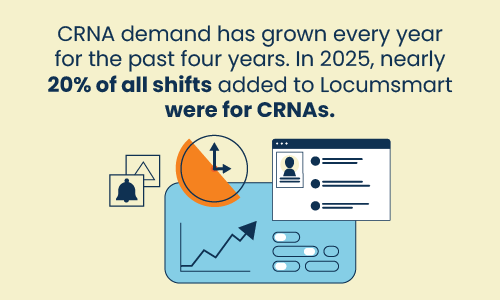
CRNA demand has grown every year for at least the past four years. In 2025, nearly 20% of all shifts added to Locumsmart were for CRNAs. “Will we hit 22%?” Lavers asks. “I don’t know. It’s got to plateau at some point.”
In terms of total expenditure, the other high-demand specialties in 2025 were hospitalist, gastroenterology, hematology, and oncology. This is only a slight shift from 2024, when OB-GYN was in the top five instead of gastroenterology. Year over year, gastroenterology grew by 136%, while OB-GYN grew by 33%.
“It’s worth noting that Locumsmart, as a platform, almost doubled in size in 2025 from 2024. So, if the number is under 100% growth, it’s actually underperforming the market. If it’s over 100% growth, it’s over-performing the market,” Lanvers points out.
Plan smarter: How to predict locum tenens usage using data analytics
Talent scarcity translates into wage growth
The demand for surgical procedures—and a scarcity of surgical specialists—translated into growth in the median hourly rate for locums in these specialties. Pediatric surgeons and vascular surgeons were among the specialties with the lowest average number of candidates. “This isn’t surprising, because there are just not as many surgeons,” Lanvers says.
Orthopedic surgeons saw a 21% growth in the median hourly rate, while pediatric surgeons gained 18%. Trauma surgeons and cardiovascular surgeons also had double-digit growth in their median hourly rate.
A supply/demand imbalance is stabilizing
Overall, Locumsmart saw a surge in demand for locums in 2025. “Not only did we double the number of our clients last year, but the demand for services within that base grew,” Lanvers explains. The increase in demand stretched across a candidate pool that hadn’t grown at the same rate. This imbalance led to an increase in the median days-to-fill from 6.1 days in 2024 to 6.8 days in 2025.
The trend is beginning to reverse in 2026, Lanvers says, with HCO demand showing signs of tapering off. “I anticipate that median days-to-fill will probably revert to lower than 2024 numbers in 2026 as the pendulum is now swinging the other way,” he says. “For an average specialty, if an HCO was opening up ten new needs a year in 2025, it’ll probably look like seven in 2026. Candidates will have fewer opportunities to choose from, which means that they will be willing to be presented more quickly.”
Locum tenens trends point to shifts in the overall physician market
Often, locums staffing trends are leading indicators for overall physician hiring. “The way I think about locums is like the canary in the coal mine,” Lanvers says. “When you see surging specialties or declining specialties, you can anticipate that those trends will carry into the rest of the market 12 months later.”
For example, Locumsmart began to record a surge in CRNA demand in 2024. By 2025, that surge was being felt in all physician hiring. “And I imagine that’s still reverberating in 2026,” he says. With demand for locums gastroenterologists up 136% in 2025, recruiters will likely struggle to fill gastroenterologist roles this year.
Locums hourly rate changes are another key indicator. “If you see hourly rates going up significantly, then you know that your salary ranges are going to be affected as well,” Lanvers says.
Increase revenue: How to streamline locum tenens payer enrollment and maximize ROI
Geographic demand patterns: Why rural markets still lead
While the data reveal changing demands among specialties, one thing remains consistent: locums demand is highest in low-density rural communities. “These are the traditional hotbed locums areas,” says Lanvers. The geographic patterns revealed in the market trends report are also influenced by areas of concentration of the healthcare organizations that utilize Locumsmart.
High-utilization states like Wisconsin, Pennsylvania, Missouri, Minnesota, Illinois, and Maine share commonalities in that they all have colder climates, wide open spaces, and large rural populations.
“Oftentimes, those populations have very large draw areas. These tiny towns have huge hospitals in them, and they’re drawing from gigantic geographic areas. These areas have traditionally had high locums utilization because it’s more difficult to recruit permanent staff,” Lanvers says.
Locum tenens is a key lever for a proactive workforce strategy
Whether a health system serves a rural community or a large urban core, locums analytics can help proactively plan for specialty needs. Locumsmart’s predictive analytics enable systems to accurately budget their locums spend for the fiscal year. “Understanding which gaps are going to be the most difficult to fill allows you to dedicate resources, time, and energy in those areas,” Lanvers says.
Analytics also enable health systems to effectively utilize locums as part of their proactive healthcare workforce planning. These days, locums is one part of an integrated strategy that encompasses permanent providers, locum providers, and moonlighters.
“The evolution is from looking at each of these things in silos and connecting all the dots into a full workforce services view. If you’re thinking of your workforce services as just your staff employees, you’re missing out on a huge part of the solution, and you’re probably not going to get ahead of your problem anytime soon,” Lanvers says.
Get the details: 7 essential reports HCOs need for locum tenens management
Future outlook: Technology and workforce pressures
One unknown in healthcare staffing trends is the impact technology will have on physician demand. Could AI or robotics fill in the gaps and lessen the impact of physician shortages?
“Technology innovation has the potential to reduce the staffing pressure many hospital systems are seeing because the one thing we do know is that there are not enough physicians,” Lanvers says.
He points to radiology as an example of how AI could supplement the physician workforce. “AI can do reads now that are better than humans. How long before the government is willing to say that’s okay? Regulation will probably put the biggest brakes on innovation,” he says.
To learn more, download the full Locumsmart Market Trends Report or connect with Locumsmart to explore how data-driven insights can support your workforce strategy.